
Some Days I Almost Feel as Though I Have a Magic Wand


Last week, I was invited to dinner by a longstanding client, Sam. This was partly a social occasion, but mostly an opportunity to observe a rather puzzling change in the behaviour of her Labrador, Basil.
Sam and I have known each other for many years. Basil is the third Labrador she has trained with me and Caroline, so we have come to know one another pretty well. Both Basil and Luna are now beautifully trained dogs. They behave very nicely when they are out and are doing brilliantly.
However, even dogs that have received a great deal of thoughtful training can develop new and unexpected sensitivities as they mature. Basil is now about four, and Sam had noticed a sudden change in him around the time she was preparing dinner.
She wondered whether it might be connected to the smells from the spicy food she enjoys cooking, or perhaps to the noises in the kitchen. The cooker hood is quite loud, pans and dishes clatter, and there is naturally a lot going on.
When Sam cooked, Basil would withdraw from the kitchen or retreat to his crate. He wouldn’t want to engage with anybody. His tail would be tucked, he would lick his lips repeatedly and his whole body seemed to express sadness and unease.
The only way for me to understand what was happening was to see it for myself. Fortunately, that meant being invited to dinner — and Sam is a very good cook, so this was no hardship!
Watching and waiting
When I arrived, Basil was delighted to see me. He was excited, animated and full of energy.
Sam began cooking straight away. She switched the cooker hood on at different settings, moved pans around and generally created all the sights, sounds and smells that would normally accompany dinner preparation.
For the first ten minutes or so, Basil seemed absolutely fine.
It was important, though, to remember that I had only just arrived. His energy was high and he was still excited to see me. As that initial excitement gradually dissipated over the following ten or fifteen minutes, we began to see the behaviour Sam had described.
Basil became quieter and increasingly withdrawn. His tail dropped, the licking began and he looked thoroughly unhappy.
My immediate instinct was that Basil’s initial excitement had temporarily overridden whatever he was experiencing around the cooking. As his energy dropped, the unhappy behaviour returned.
It was only a hunch. I couldn’t know with certainty whether his change in behaviour was directly connected to arousal or adrenaline, but it gave us something simple and safe to explore.

A small experiment
I explained my thinking to Sam and suggested that we experiment.
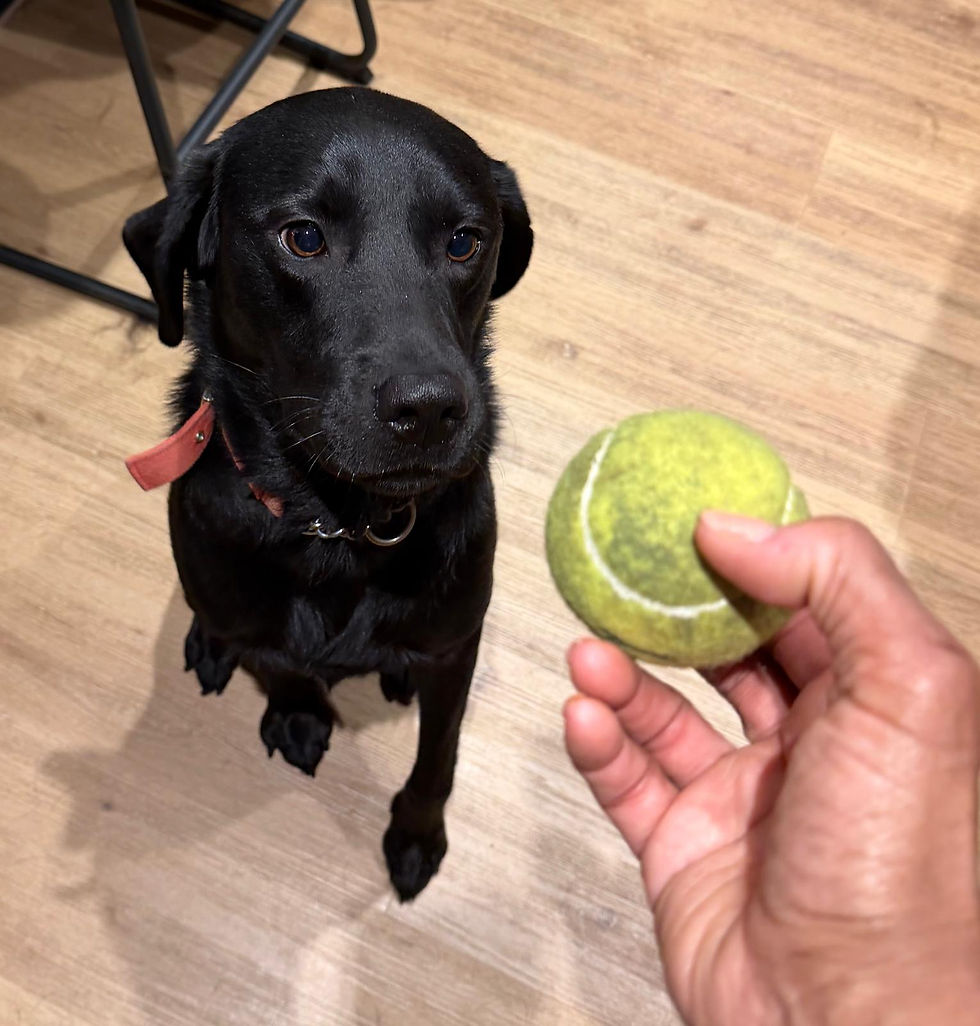
We brought out a ball and began playing with Basil. We bounced it around and encouraged him to join in. He engaged with us readily and became much more upbeat. Sam felt he wasn’t quite as enthusiastic as he could sometimes be, but the change in him was nevertheless quite marked.
After two or three minutes, we put the ball away. Sam continued cooking throughout.
Even if my initial thoughts about his energy levels weren’t quite right, pairing a short, enjoyable game with the sounds, smells and activity of cooking might begin to change how Basil felt about that time of day.
For a while, all was well. About ten minutes later, he seemed to begin dropping again, so we brought the ball out for another very brief game and then put it away once more.
Basil recovered and remained much happier.
Eventually, of course, the meal was ready and we had to stop experimenting and eat it!

The real work begins afterwards
One evening could never tell us whether we had found the answer. The only way to discover that was for Sam to continue the experiment after I had gone.
She trusted my instinct enough to give the simplest possible solution a fair chance.
For the past week, just before she begins cooking, Sam has taken Basil into the garden and played ball with him for two or three minutes. She then brings him inside and carries on preparing dinner as usual.
The change has been remarkable.
Sam reports that Basil’s whole manner has altered. He is much more interested in what everybody is doing and is actively seeking out positive engagement with both Sam and her partner, Ella.
In Sam’s words, she has her dog back — and then some.
Changing the feeling, not just the behaviour
We may never know exactly how Basil’s unhappiness around dinner preparation began. Perhaps something startled or unsettled him one evening. Perhaps several small experiences became linked together until the sounds, smells and routines of cooking began to predict an uncomfortable feeling.
Dogs make associations all the time, and we don’t always witness the moment when those associations are formed.
What mattered was that we didn’t force Basil to stay in the kitchen, repeatedly expose him to something he found difficult or treat his withdrawal as disobedience. We watched him carefully, considered what his body language might be telling us and tried a small change.
The ball game wasn’t intended simply to distract him. It helped alter his emotional state and introduced a positive experience at the very beginning of the cooking routine. Over repeated evenings, that appears to have changed Basil’s expectation of what dinner preparation means.
There are occasional days in my work when I feel as though I have a magic wand. They are few and far between, but this was definitely one of them.
In truth, though, the “magic” came from observation, a trusting relationship and Sam’s willingness to continue the work after I had left. I had the fun part: playing ball, watching Basil’s response and enjoying a lovely dinner.
Sam did the part that really mattered. She took a small idea, repeated it consistently and gave Basil the opportunity to feel differently.
Sometimes the most powerful changes begin with the simplest experiment.
Until next time,
Avril Clinical Dog Behaviourist and Trainer thedogcalmer
Calm dogs. Confident humans. Better relationships.


Comments